Talk 1: From bacteria aggregation to Rubik’s cube aggregation
The terminology “synchronization" denotes the adjustment of rhythms via weak interactions in an ensemble of oscillators, and it is one of collective phenomena appearing in oscillatory systems. Despite of its ubiquitous presence in our nature, it became a scientific subject only after Huygen's observation on the asynchronous dynamics of two pendulum clocks in the middle of the seventeenth century. Moreover, its systematic theoretical study based on mathematical models has been done only in a half century ago by two pioneers Arthur Winfree and Yoshiki Kuramoto. In particular, the Kuramoto model has been extensively used as a prototype model for synchronization. In this talk, we provide a brief overview on Kuramoto’s hierarchy for tensor aggregation consisting of four distinct aggregation models such as the Kuramoto model, the swarm sphere model, the Lohe matrix model and the Lohe tensor model, and discuss inclusive relations between them.
Talk 2: Emergent dynamics of the inertial spin model on Euclidean spaces
In this talk, we discuss qualitative and quantitative flocking estimates for the inertial spin model on the three-dimensional Euclidean space and its high-dimensional generalization. First, we present several mathematical frameworks leading to the exponential decay of the inertial spin model. For this, we derive a system of differential inequalities for relative kinetic and spin energies, and then we explicitly obtain exponential flocking under the proposed frameworks.
Second, we propose a high-dimensional inertial spin(HIS) model which generalizes the three-dimensional inertial spin model and study its emergent behaviors. For the generalization of the IS model to the high-dimensional Euclidean space, we replace the cross product by the multiplication via skew-symmetric matrix, and identify a new set of constants of motions which are conserved along the proposed model. We provide two sufficient frameworks leading to the collective behaviors of the HIS model leading to qualitative and quantitative emergent dynamics in terms of system parameters and initial data.
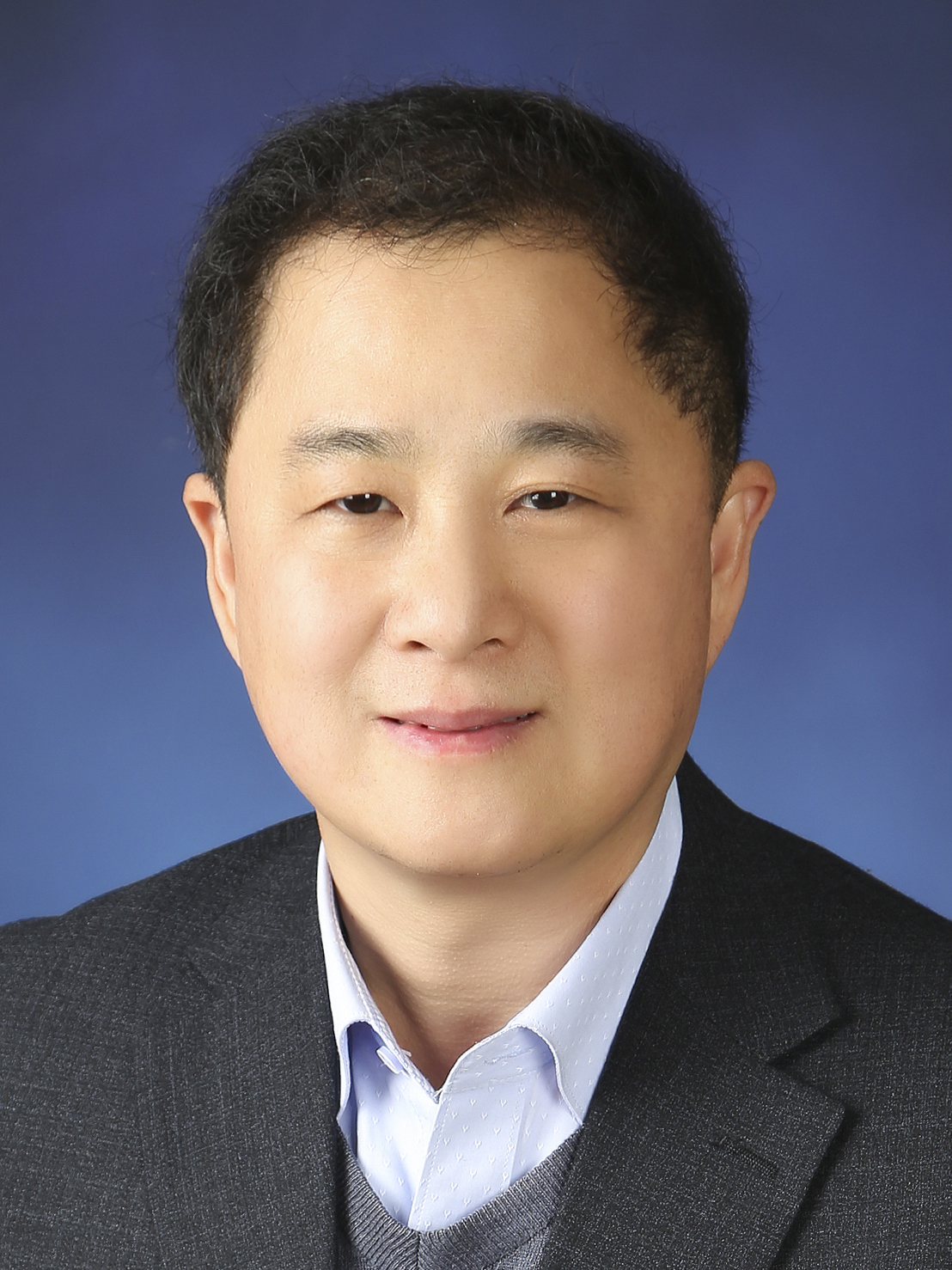
Biography
Professor Seung Yeal Ha is a professor at the Department of Mathematical Sciences, Seoul National University in Korea since 2003. He received a B.S. degree with Summa cum Laude from Seoul National University in 1997 and Ph.D. degree from Stanford University in 2001. After two and half year post-doc experience at Univ. of Wisconsin-Madison right after his Ph.D., he has been working for Seoul National University. Ha’s primary research interests are applied nonlinear analysis such as hyperbolic conservation laws, the kinetic theory of gases and collective dynamics of many-body interacting systems, application of flocking theory to finance and sociology. He has received numerous honors and awards including 14th Presidential Young Scientist Award in 2010, 17th Korea Science Prize in 2017 and KSIAM-Kumkok prize in 2023. He has given several distinguished lectures in the past such as a plenary talk at 1st AMC(Asian Mathematics Conference) in 2013, and invited talk at ICM 2014, and a plenary talk at HYP 2014 (the largest conference in the hyperbolic problems) and keynote lecture at 32nd International Symposium on Rarefied Gas Dynamics in 2022. He is currently a member of the Korean Academy of Science and Technology.
Registration: https://www.wjx.top/vm/exO0OWy.aspx#
Recording: https://archive.ymsc.tsinghua.edu.cn/pacm_lecture?html=From_bacteria_aggregation_to_Rubik_s_cube_aggregation_Emergent_dynamics_of_the_inertial_spin_model_on_Euclidean_spaces.html